One God Against the Trinity
Biblical Study
The question of who God is and how He revealed Himself in Yeshua is not a small matter. It touches the very foundation of faith, worship, and obedience. For this reason, Scripture must be allowed to speak for itself, without later philosophical systems being imposed upon it.
This study examines the doctrine commonly called "the Trinity" in light of Scripture alone, and shows that the biblical testimony consistently reveals one Yehovah, who is Spirit, acting and making Himself known through the Son rather than three co-equal, co-eternal persons.
God Is Spirit -- Not One Person Among Many
"God is Spirit." (John 4:24)
This statement does not describe one aspect of God or one person within God. It describes what God is. Yehovah is Spirit by nature. Spirit is not a separate divine being; Spirit is the mode of God's existence and presence.
"There is ONE body and ONE Spirit... ONE God and Father of all." (Ephesians 4:4-6)
If there is one God, and one Spirit, then the Spirit cannot be a separate co-equal person alongside God. The Spirit is God Himself, holy by nature, active by will, and indivisible in being.
There are not multiple Holy Spirits. Scripture never speaks of "Holy Spirits" in the plural. Holiness belongs to Yehovah alone:
"Who is like You, O Yehovah, glorious in holiness?" (Exodus 15:11)
Therefore, the Holy Spirit is not another divine person -- it is Yehovah Himself, present and acting in holiness.
The Son and the Indwelling of Yehovah
"God was in Messiah reconciling the world to Himself." (2 Corinthians 5:19)
Not beside Messiah. Not divided into Messiah. But in Messiah.
Yeshua is not presented as a second God, nor as an independent divine person acting alongside the Father. He is presented as the Son, the one in whom Yehovah chose to dwell bodily:
"In Him dwells all the fullness of deity bodily." (Colossians 2:9)
This means that the body of Yeshua was not merely inspired by God, but was the dwelling place of Yehovah's fullness. The Son was real, obedient, suffering, and submissive, but the power, authority, and divine works flowing through Him belonged to Yehovah alone.
"The Father who dwells in Me, He does the works." (John 14:10)
"I can do nothing of Myself." (John 5:30)
These are not the words of an equal acting independently. They are the words of the Son through whom one God is working.
The Resurrection: One Action, One God, Spoken Three Ways
Scripture gives three complementary statements about the resurrection of Yeshua:
1. The Father raised Him: "God raised Him from the dead." (Acts 2:24)
2. Yeshua said He would raise the temple of His body: "Destroy this temple, and in three days I will raise it up." (John 2:19)
3. The Spirit raised Him: "The Spirit of Him who raised Yeshua from the dead..." (Romans 8:11)
These are not three actors performing one miracle. Scripture never says that. Instead, it describes one Yehovah acting, expressed relationally.
Acts names the source -- God. John records the agency -- God acting through the Son. Romans explains the means -- God acting by His Spirit.
Notice carefully: Romans does not say "the Spirit raised Yeshua." It says "the Spirit of Him who raised Yeshua." The Spirit belongs to the same One who performed the act.
This language destroys the idea of three independent divine persons acting together. It presents one will, one power, one source of life.
Why This Cannot Support the Trinity
The Trinity requires:
- Three distinct divine persons.
- Each possessing independent will and consciousness.
- Acting together as equals.
But Scripture presents:
- One God.
- One Spirit.
- One will.
- One source of authority.
The Father is not a separate being from God. The Spirit is not a separate being from God. The Son is not a second God alongside God.
Yehovah is Spirit. Yehovah dwelt in the Son. Yehovah raised Yeshua from the dead by His Spirit.
This is not philosophical theology. This is textual reality.
The Name of Yeshua and the Revelation of Yehovah
The name Yeshua means "Yehovah is salvation." It does not mean "a second divine person saves," but that Yehovah Himself saves, and He does so through the Son He revealed and anointed.
"I, even I, am Yehovah, and besides Me there is no savior." (Isaiah 43:11)
Yet salvation comes through Yeshua because Yehovah was in Him.
Final Conclusion
There is one Yehovah.
Yehovah is Spirit.
His Spirit is holy.
Yeshua is the Son in whom Yehovah dwelt bodily.
The resurrection was the work of one God, not three persons.
The Trinity is not clarified by Scripture -- it is contradicted by it.
Truth does not multiply God. Truth reveals Him.
Infographic
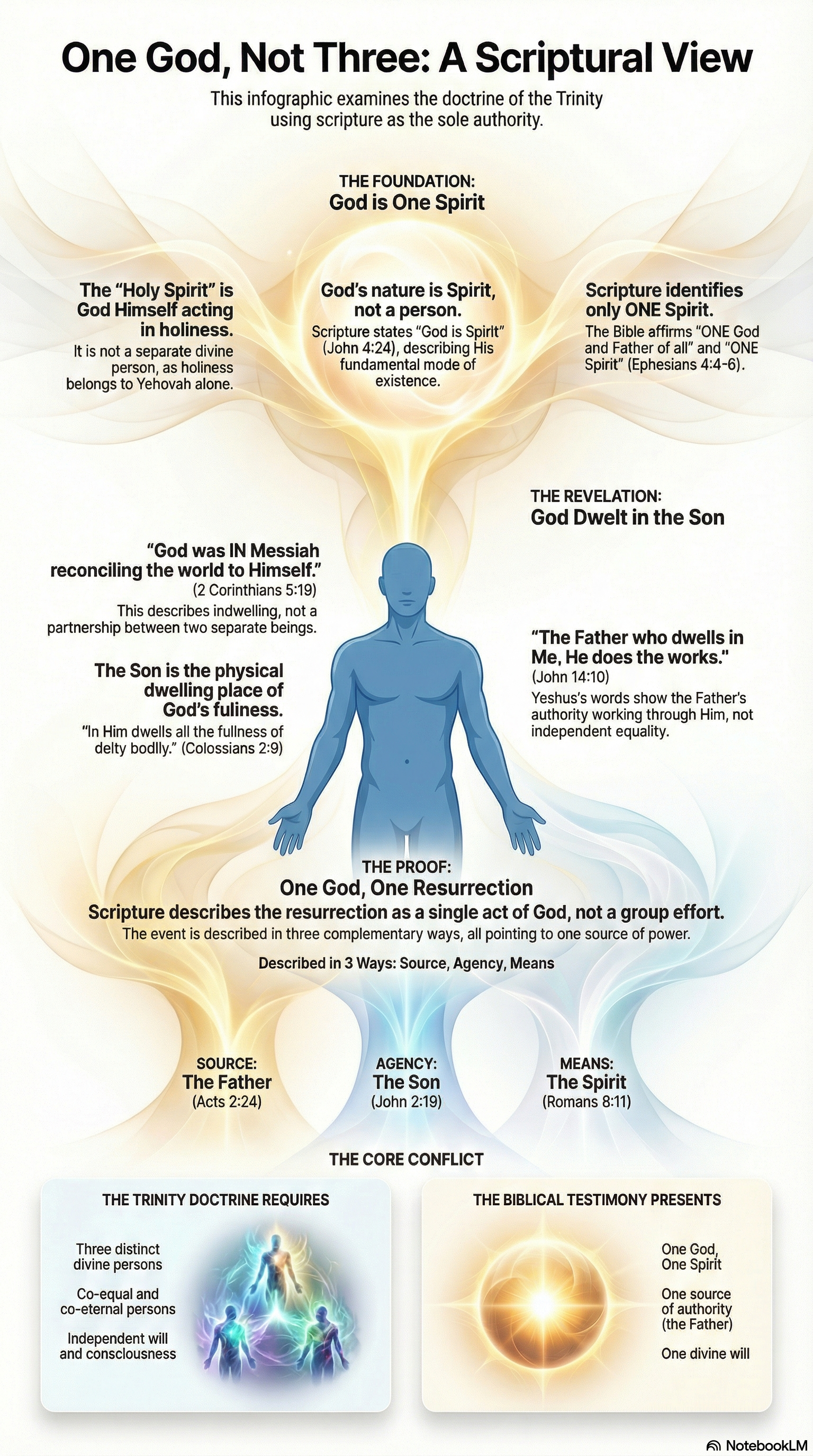
Open infographic in a new tab for full-size viewing.
Study Slideshow (PDF)
Open slideshow in a new tab for full-screen viewing. If the slideshow does not load, download the PDF here.
Original Post
Report an Issue
While we thoroughly check each study, there may sometimes be errors that miss our notice. We appreciate your feedback.