Yehovah Revealed In Messiah
This seven-part study follows the outline from Genesis to Revelation, asking how Scripture can say both that God is invisible and that Yehovah has appeared, spoken, dwelt among His people, and finally revealed Himself bodily in Yeshua the Messiah.
The series is organized progressively: first establishing who Yehovah is; then tracing the Messenger of Yehovah, the Word becoming flesh, the names and works of Yehovah, His glory and worship, the Torah test, the Spirit of Yehovah, and the final testimony that God will be all in all.
A Note On Terms Used In This Study
Throughout this study:
- Yehovah is used for the covenant name of God revealed in the Hebrew Scriptures.
- Elohim is the Hebrew word often translated “God.”
- Lord is frequently used in English translations where the Hebrew text contains the divine name Yehovah.
- God is used at times in broader English expression or when quoting passages commonly translated that way.
- Spirit, Holy Spirit, and Spirit of Yehovah refer to the invisible divine presence and nature of the one God.
This study maintains that:
- Yehovah is one,
- God/Elohim is Spirit,
- and Yeshua is the visible manifestation of the invisible God/Elohim revealed in flesh.
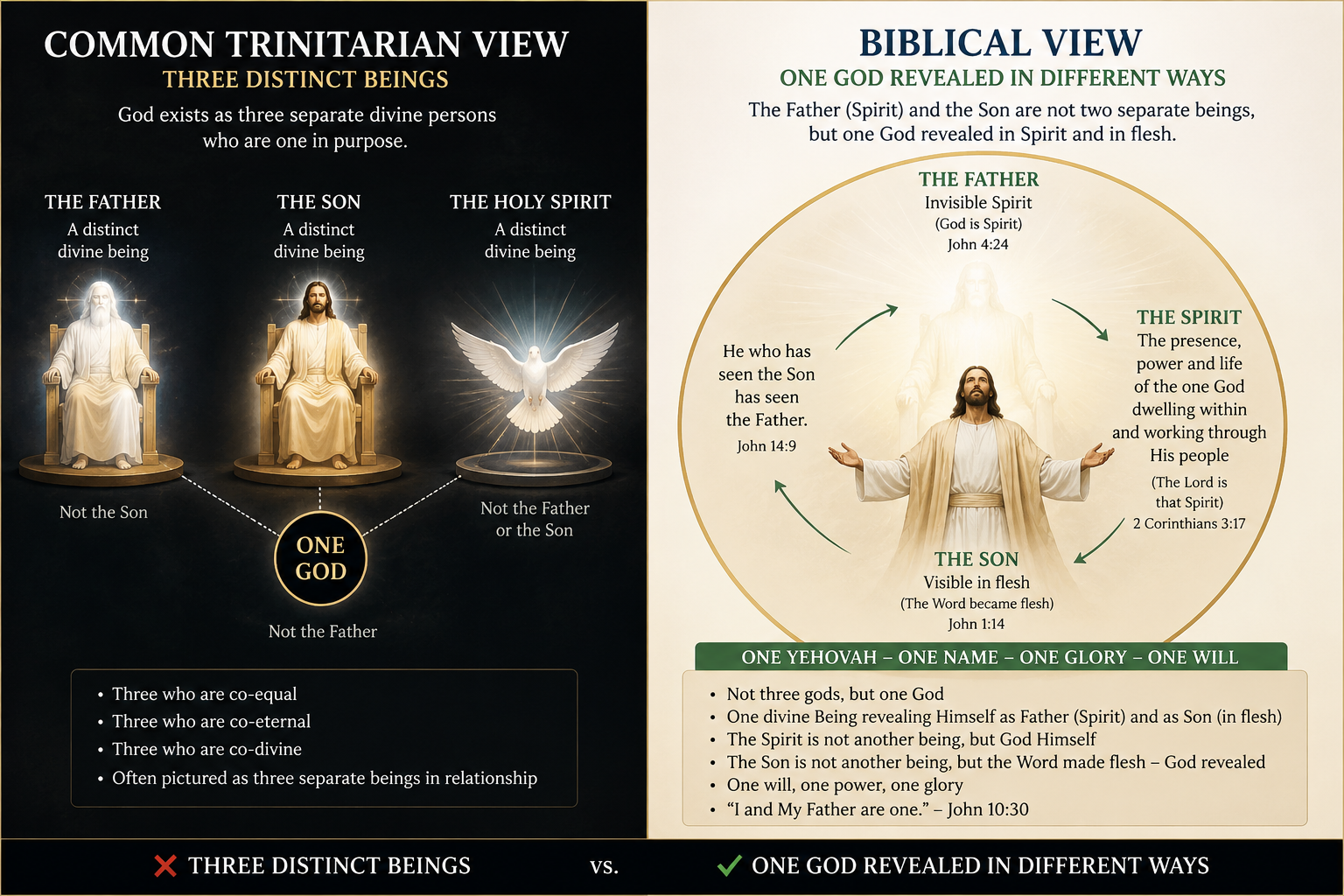
Open infographic in a new tab for full-size viewing.
Study Organization
The seven parts build on one another. Each page can stand alone, but the clearest reading is sequential: foundation, manifestation, fulfillment in Messiah, divine names and works, glory and worship, covenant testing, and final restoration. Supplemental add-ons expand key questions raised inside the main series.
Who Is Yehovah?
Scripture introduces the one Creator and asks how the invisible God could be seen.
Part 2The Messenger Of Yehovah
The Messenger speaks as God, carries Yehovah's name, and receives divine reverence.
Part 3The Word Became Flesh
The eternal Word became truly human, revealing the invisible Father in Messiah.
Part 4The Names And Works Of Yehovah
The apostles apply Yehovah's names, works, and promises directly to Yeshua.
Part 5The Glory And Worship Of Yehovah
Yeshua receives the glory and worship that Scripture reserves for Yehovah.
Part 6The Torah Test
Torah forbids following another god, yet the apostles faithfully proclaimed Yeshua.
Part 7God All In All
One God, one Spirit, and the final restoration in which God is all in all.
Add-OnWhy Did Yeshua Pray?
The Father, the Son, and the incarnation: why Yeshua’s prayers do not make Him another God beside Yehovah.
Recommended after Part 7 Add-OnThe Right Hand of God
Power, authority, and the exalted Messiah: why sitting at God’s right hand does not teach two gods seated side by side.
Recommended after Part 7 SupplementOne God Against the Trinity
Written by my spouse
A companion study moved under this series as supplemental reading after the final part.
Recommended after Part 7Report a Technical Issue
Please use this form to report technical problems with the site, media, links, layout, or page loading.