The Heart of Corruption
Genesis and the Two Paths
Theme: Walking in light amid corruption.
Focus: The contrast between two ways of life - one that rejects Yehovah's ways and one that walks faithfully in them.
This study draws together the testimony of Genesis 4-7, Isaiah 1, and 1 John 1 to reveal a single, consistent thread throughout Scripture.
Corruption is defined as abandoning Yehovah's ways.
Righteousness is defined as walking faithfully in them.
Judgment comes upon those who reject His ways.
Preservation belongs to those who walk in them.
1. The Two Ways Begin (Genesis 4)
Genesis 4 introduces the first visible contrast between two paths. Both Cain and Abel worship. Both bring offerings. The difference is not outward activity, but posture toward Yehovah's instruction.
"If you do well, will you not be accepted? And if you do not do well, sin is crouching at the door..."
Cain is not left without instruction. He is not deprived of opportunity. He is confronted with a choice. Instead of responding with humility, Cain rejects correction, nurtures jealousy, and ultimately murders his brother. When confronted, he refuses responsibility.
Refusal of correction
Resistance to accountability
Rejection of Yehovah's ways
At the end of the chapter, two trajectories emerge:
Cain's line, marked by pride, self-exaltation, and increasing wrongdoing
Seth's line, marked by calling upon the Name of Yehovah
From the beginning, Scripture presents two paths, not confusion.
2. Quiet Faithfulness Preserves Life (Genesis 5)
Genesis 5 is not filler. It testifies that while corruption grew in the world, faithfulness was still being preserved. Generation after generation, the knowledge of Yehovah continued through the line of Seth. In the middle of this genealogy stands Enoch:
"Enoch walked with Elohim."
This is not a moment of belief. It is a description of a life ordered around alignment with Yehovah. Genesis 5 shows us that walking in light often appears quiet, uncelebrated, and ordinary. Yet it is this faithful continuity that preserves the line through which life continues.
3. Corruption Defined by Scripture (Genesis 6)
By Genesis 6, corruption has spread across the earth. Scripture describes the condition clearly:
"All flesh had corrupted their way on the earth."
This is not merely about broken rules. It is about corrupted ways of living. The earth is said to be filled with "violence." The Hebrew word used is חָמָס (hamas). This word does not mean only physical brutality. It refers to corruption expressed toward others through wrongdoing, including:
Injustice
Oppression
Deceit
Exploitation
Betrayal
Abuse of authority
Moral disorder in relationships
The earth was not simply dangerous. It was morally disordered. Yehovah's ways for justice, truth, and righteousness had been abandoned.
In contrast, Scripture presents Noah clearly:
"Noah found favor in the eyes of Yehovah."
"Noah was a righteous man... Noah walked with Elohim."
"Noah, a preacher of righteousness."
Noah did not blend into the culture around him. He walked faithfully in Yehovah's ways and proclaimed righteousness while the world rejected it.
The world rejected righteousness.
Noah walked in righteousness.
This is why preservation came to his household.
4. Judgment and Preservation (Genesis 7)
Genesis 7 removes all ambiguity. Yehovah says directly to Noah:
"For I have seen that you are righteous before Me in this generation."
Deliverance is not portrayed as random. It is connected to righteousness. Throughout the chapter, Scripture repeatedly emphasizes:
"And Noah did according to all that Yehovah commanded him."
The door of the ark is shut by Yehovah Himself. This reveals that mercy is real, provision is real, and boundaries are real. The path of life was made clear, and the path of destruction was the result of rejecting that way.
Yehovah responds to corruption.
Yehovah preserves those who walk faithfully.
Judgment comes upon those who abandon His ways.
5. Corruption Within a Religious People (Isaiah 1)
Isaiah 1 demonstrates that corruption is not limited to lawless societies. It can exist among a people who claim to belong to Yehovah. Israel still worshiped. They still brought offerings. They still observed appointed times. Yet Yehovah declares that their worship had become unacceptable because their lives were not aligned with His ways.
He describes their condition:
Outward worship without inward faithfulness
Religious practice without justice
Ritual without obedience
"Your hands are full of blood..."
This is covenant language. It reflects the same corruption described in Genesis 6. They were harming others through injustice and unrighteous conduct while maintaining religious appearance.
Yet even here, Yehovah extends invitation:
"Wash yourselves, make yourselves clean... cease to do evil, learn to do good."
The issue is not abandonment of worship. It is return to faithful walking.
6. Walking in the Light Defined (1 John 1)
1 John 1 brings the theme into clear language for believers:
"Elohim is light, and in Him is no darkness at all."
John defines fellowship not by profession but by walk:
"If we say that we have fellowship with Him, and walk in darkness, we lie and do not practice the truth."
"If we walk in the light... the blood of Yeshua the Messiah cleanses us from all sin."
Walking in light is not emotional experience. It is alignment with truth, righteousness, and obedience. Confession is not shame. It is agreement with truth and realignment with Yehovah's ways.
This echoes every passage we have studied:
Cain refused correction.
The world before the flood rejected righteousness.
Israel practiced religion without alignment.
John confronts claims without faithful walking.
The Two Paths Throughout Scripture
| The Path of Corruption | The Path of Righteousness |
|---|---|
| Rejects correction | Receives instruction |
| Defines right and wrong independently | Aligns with Yehovah's standard |
| Practices religion without obedience | Walks faithfully in covenant |
| Harms others through injustice | Lives in justice and truth |
| Ends in judgment | Leads to preservation |
Scripture never presents a third path.
Conclusion: The Heart of Corruption
Corruption is not merely immoral behavior. Corruption is the rejection of Yehovah's ways.
Righteousness is not merely belief. Righteousness is walking faithfully in those ways.
From Genesis to the Apostolic writings, the testimony remains consistent:
Those who abandon Yehovah's ways perish in their path.
Those who walk faithfully are seen, known, and preserved.
The question Scripture continually places before us is not: "What do you claim?" It is: "Which path are you walking?"
The two paths have always existed. The choice has always been clear.
Study Video
Two Paths Infographic
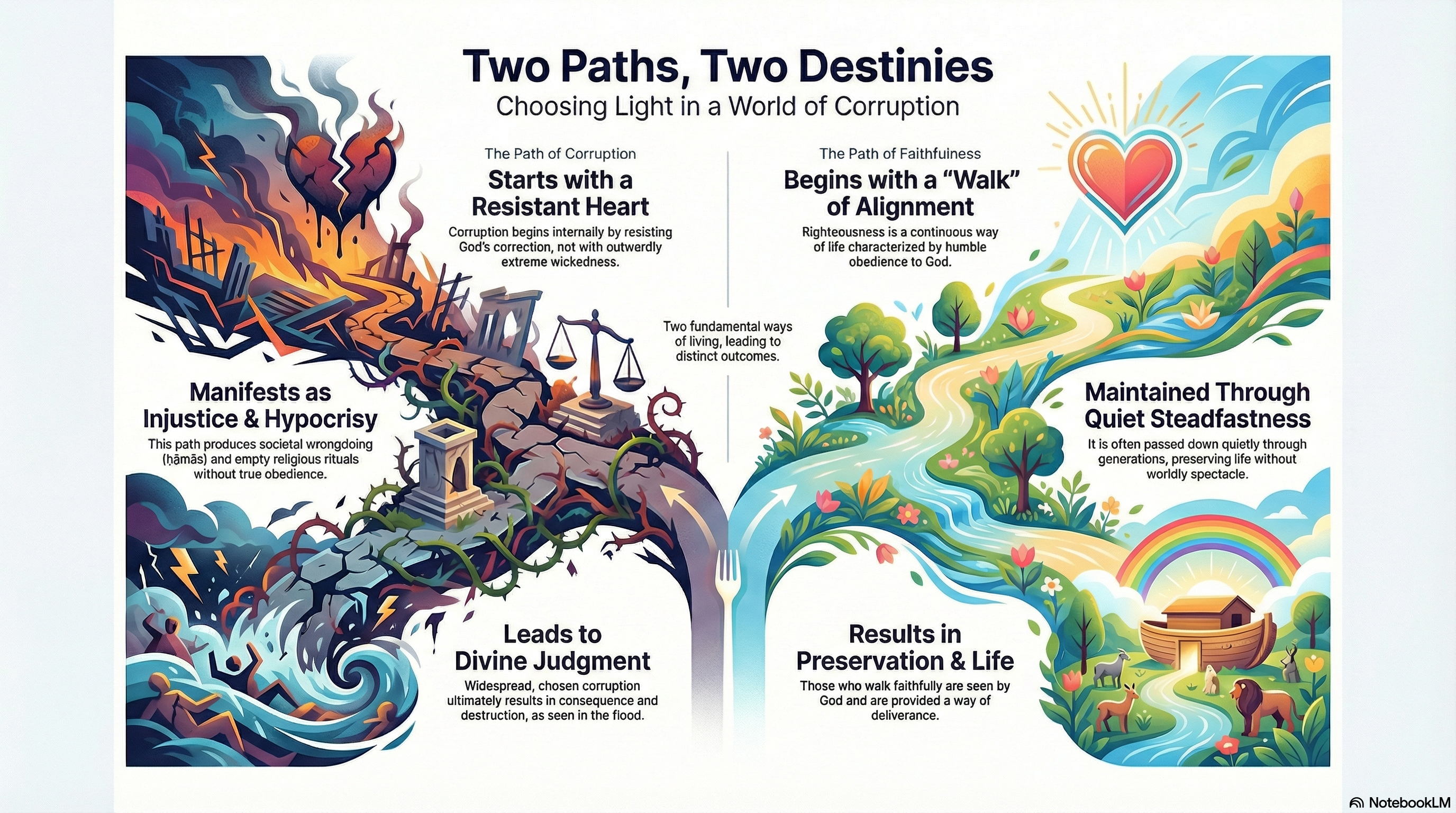
Open infographic in a new tab for full-size viewing.
Study Slideshow (PDF)
Open slideshow in a new tab for full-screen viewing. If the slideshow does not load, download the PDF here.
Note: The study video and slideshow were created using Notebook LM and other AI tools.
Report an Issue
While we thoroughly check each study, there may sometimes be errors that miss our notice. We appreciate your feedback.