Scattered and Gathered
A Unified Study in Genesis 8–11, Psalm 33, and Acts 2
Scripture does not unfold as disconnected events. From preservation to rebellion, from scattering to restoration, one pattern remains: Yehovah preserves life by mercy, human pride resists divine order, and Yehovah governs history toward His purposes. This study traces that single thread through Genesis 8–11, Psalm 33, and Acts 2—passages that speak with one voice about covenant, restraint, and divine counsel.
Part One: Genesis — Life Preserved and Boundaries Established
Restoration Moves by Covenant Faithfulness
Genesis 8 begins with a simple statement:
"Elohim remembered Noah."
This is not forgetfulness corrected. Throughout Scripture, when Yehovah "remembers," He acts in faithfulness toward His covenant. Restoration begins with Him.
The waters recede gradually. The fountains close. The depths withdraw. Dry ground reappears. Nothing happens in disorder. Restoration unfolds with purpose and timing.
Even when the earth appears ready, Noah does not leave. He waits for instruction.
"Go forth of the ark…" (Genesis 8:15–16)
He is not led by circumstance. He is led by the Word.
When Noah exits, his first recorded act is worship. He builds an altar. Deliverance leads to reverence before productivity.
Yehovah then establishes stability within creation:
"While the earth remaineth, seedtime and harvest… shall not cease." (Genesis 8:22)
Restoration begins with Yehovah's covenant faithfulness and is walked out through faithful obedience. Genesis presents both together. Yehovah acts in mercy, and Noah remains within that mercy by continuing to walk in the direction of obedience, even as he continues to grow.
Scripture does not separate favor from Noah's life. It immediately tells us that he was righteous, that he walked with Elohim, and that he did what he was commanded. Favor, faithfulness, and obedience are shown as part of the same covenant reality.
At the same time, Scripture does not portray covenant faithfulness as instant flawlessness. Those who walk with Yehovah grow, learn, repent, and continue forward. Mercy meets sincere pursuit.
Covenant Boundaries Protect Life
Genesis 9 begins with blessing:
"Be fruitful, and multiply…" (Genesis 9:1)
Life continues because Yehovah wills it.
This blessing carries a direction: fill the earth. The instruction to multiply includes movement outward. Yehovah gathers humanity into the ark to preserve life. Now He sends them outward to steward it. Gathering and scattering both serve His purposes.
The chapter then describes a changed creation. Fear now exists between animals and humans (Genesis 9:2). Scripture offers no further explanation, and we remain within what is written.
Yehovah grants permission regarding food. Since Noah already distinguished between clean and unclean animals when entering the ark (Genesis 7:2), this permission is given within an existing awareness of distinction.
"Every moving thing that liveth shall be meat for you…" (Genesis 9:3)
Then a boundary is established:
"But flesh with the life thereof, which is the blood thereof, shall ye not eat." (Genesis 9:4)
Scripture gives the reason. Blood represents life.
This principle remains consistent throughout Scripture:
"The life of the flesh is in the blood…" (Leviticus 17:11)
Believers are later instructed to abstain from blood (Acts 15:20, 29).
This is not restriction for control. It is protection for life. Yehovah reveals Himself as an Elohim of life. His instruction flows from His nature. His commandments preserve life.
Human life is affirmed as sacred because humanity bears the image of Elohim (Genesis 9:6). Even after judgment. Even after failure. Life remains precious.
Yehovah then establishes covenant:
"I establish my covenant with you…" (Genesis 9:11)
The rainbow becomes the sign of this promise (Genesis 9:12–17), a visible testimony of mercy and restraint.
The chapter does not end with perfection. Failure still appears. Human weakness remains. Deliverance does not remove the need for wisdom. Mercy does not eliminate responsibility.
The issue is never that Yehovah's instruction is flawed. Scripture consistently shows that life and protection remain with those who are sincerely walking within His ways, even as they continue to grow. Harm follows when people resist, disregard, or refuse His instruction. The direction of the heart matters.
Selah (Pause & Discuss)
When Noah came out of the ark, he built an altar to give thanks before he built a home for himself. When Yehovah answers our prayers, do we pause to thank Him first, or rush ahead to the next task?
Why do you think Yehovah places boundaries on what we eat? How does that remind us that life belongs to Him?
Part Two: Genesis — Nations and Resistance
Families Become Nations
Genesis 10 gives structure rather than spectacle. Families grow. Languages develop. Lands are settled. Nations emerge.
Scripture repeats this pattern deliberately (Genesis 10:5, 20, 31–32). This is not chaos. It is continuity. All peoples descend from one preserved family. Diversity is not presented as disorder; it is part of the unfolding account.
Babel appears within this lineage (Genesis 10:10). The setting is established before the heart is revealed.
The Anatomy of False Unity
Genesis 11 does not merely tell us that humanity was scattered. It shows us why.
One language. One people. One place.
They say:
"Let us make us a name…"
"…lest we be scattered abroad…" (Genesis 11:4)
The motives are clear. Identity becomes self-centered. Security becomes self-manufactured.
Fear of scattering reveals resistance to Yehovah's earlier instruction to fill the earth (Genesis 9:1). This reflects more than misunderstanding. Scripture presents a settled direction of the heart—not momentary failure, but resistance to the path Yehovah had given.
Yehovah does not destroy them. He restrains them. Language is confused. Communication fractures. The people disperse.
Scattering becomes both judgment and mercy. Rebellion is interrupted. Humanity is preserved.
They sought a lasting name. What remains is Babel—remembered for confusion rather than glory. Unity built on pride collapses. Gathering apart from Yehovah leads to fragmentation, not life.
Selah (Pause & Discuss)
The people at Babel were afraid to scatter, even though Yehovah had instructed them to fill the earth. Why do we sometimes feel safer following the crowd rather than walking in obedience?
What is the difference between seeking a great name for ourselves and honoring Yehovah's Name?
Part Three: Psalm 33 — Affirming the Pattern
Psalm 33 is not abstract theology. It is Israel's response to the very pattern Genesis demonstrates. Having experienced both exile (scattering) and deliverance (gathering), they declare what they have learned:
Yehovah speaks, and creation stands (Psalm 33:6–9). His word establishes boundaries. His breath gives life. Nothing exists apart from His purpose.
He sees all humanity (Psalm 33:13–15). No motive is hidden. No plan escapes His awareness. From His dwelling place, He observes every heart and understands every work.
"The counsel of Yehovah standeth for ever, the thoughts of his heart to all generations." (Psalm 33:11)
Human plans rise. Human systems expand. Human confidence grows. And yet:
"Yehovah bringeth the counsel of the heathen to nought; he maketh the devices of the people of none effect." (Psalm 33:10)
Babel is not an anomaly. It is a pattern Israel has witnessed repeatedly. Every generation that builds without Him discovers the same outcome.
The psalm then contrasts two paths:
Strength does not preserve life (Psalm 33:16–17). Armies fail. Horses stumble. Power proves vain. But those who fear Yehovah and hope in His mercy are under His care (Psalm 33:18–22).
Israel learned through scattering that life depends on remaining within Yehovah's counsel. The psalm celebrates what Genesis revealed: He governs because life depends on it.
Selah (Pause & Discuss)
The psalm says a horse (military power) is a vain thing for safety. In our lives today, what are some "horses" people often trust in instead of Yehovah? Money? Reputation? Control? Stability?
Part Four: Acts — Gathering Restored Through Truth
Acts 2 unfolds within the world shaped by Genesis, specifically during the Feast of Shavuot. Just as Torah was given at Sinai on Shavuot, here the Spirit moves in a way that brings understanding to hearts.
Nations exist. Languages are diverse. People are scattered. Jews from many nations are present in Jerusalem (Acts 2:5–11).
Yehovah initiates the moment. The Spirit is given. The disciples speak in other languages. The defining feature is not noise, but understanding.
"Every man heard them speak in his own language…" (Acts 2:6)
The message is clear:
"We do hear them speak… the wonderful works of Elohim." (Acts 2:11)
Babel produced confusion.
Acts 2 produces understanding.
A Tale of Two Names
At Babel, humanity gathered to make a name for themselves.
At Shavuot, the disciples gather to proclaim the Name of Yeshua.
Peter interprets the event through Scripture (Acts 2:14–36). He proclaims Yeshua as Messiah and Lord (Acts 2:36).
The response is conviction:
"What shall we do?" (Acts 2:37)
The answer is direct:
"Repent…" (Acts 2:38)
Repentance leads to turning. Turning leads to transformation.
A community forms:
- Devoted to teaching
- Committed to prayer
- Living in reverence
- Marked by sincerity
- Shaped by obedience (Acts 2:42–47)
This is what Yehovah-formed gathering produces. Not chaos. Not pride. Not self-centered unity. Life ordered by truth.
Selah (Pause & Discuss)
At Babel, people could not understand one another. In Acts, understanding was restored. What creates true unity in a family? Simply being together, or walking together in faithfulness to Yehovah?
The Unified Message — Closing Reflection for Our Family
Taken together, these passages form one continuous pattern:
Yehovah gathers to preserve life.
Humanity gathers to exalt itself.
Yehovah scatters to restrain rebellion.
Yehovah gathers again through repentance and truth.
The distinction is never about gathering itself—it is about what the gathering is centered upon.
Scripture does not present covenant faithfulness as instant perfection. From Noah to Abraham, from Israel to the disciples, those who walk with Yehovah stumble, learn, repent, and continue forward. What Yehovah looks for is not flawless performance but a willing heart that seeks His ways. His mercy meets those genuinely turning toward Him.
Yet mercy is never permission to remain unchanged. A heart that truly loves Yehovah will desire to trust Him, and trusting Him leads to walking in the ways He said are good. Growth, repentance, and perseverance mark sincere faithfulness.
This study is not abstract. It is personal.
Babel reminds us where pride leads. Acts reminds us where repentance leads.
Every generation faces the same question:
Will we build around our own name, or will we be gathered around His?
Study Video
Scattering and Gathering Infographic
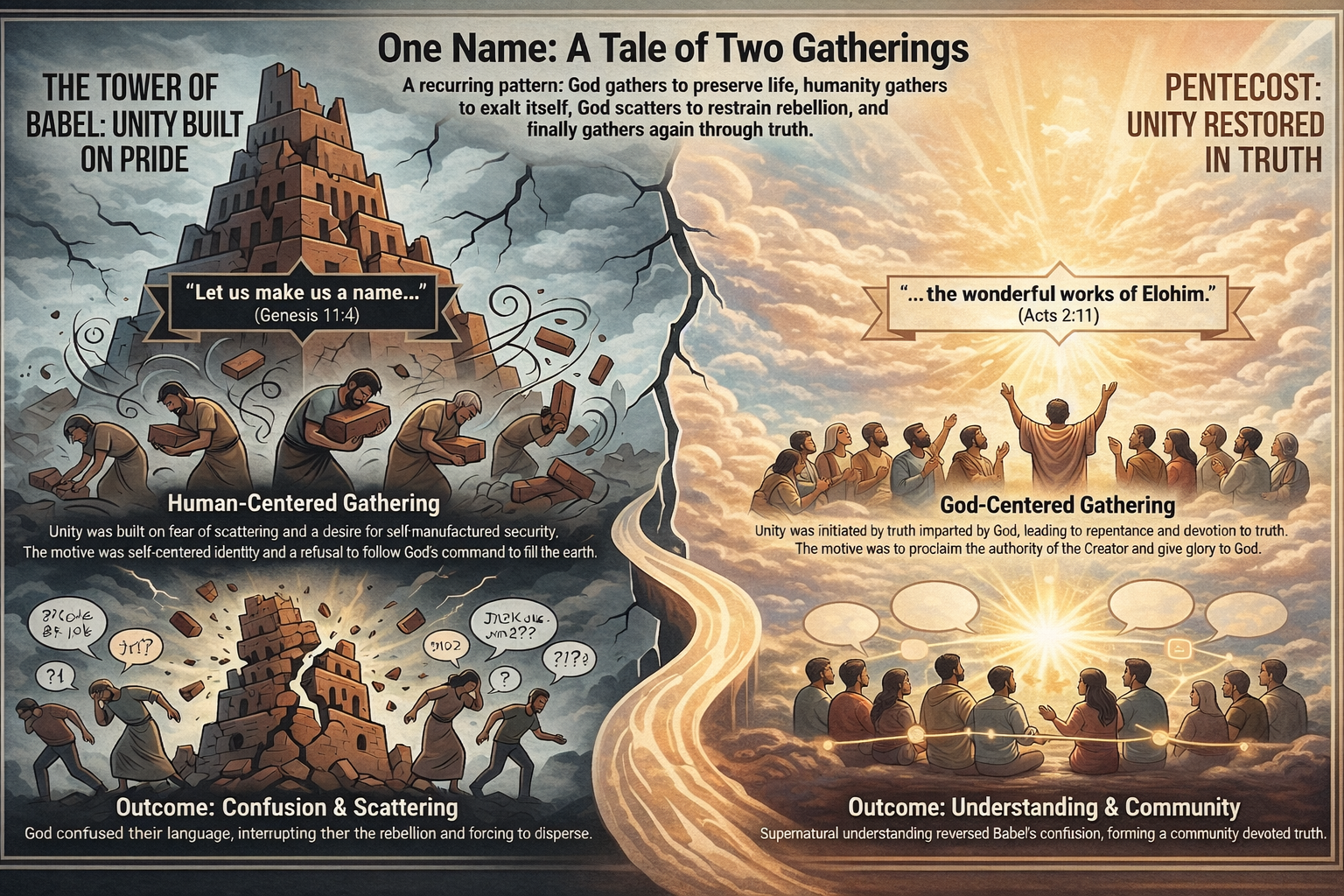
Open infographic in a new tab for full-size viewing.
Study Slideshow (PDF)
Open slideshow in a new tab for full-screen viewing. If the slideshow does not load, download the PDF here.
Note: The study video and slideshow were created using Notebook LM and other AI tools.
Report an Issue
While we thoroughly check each study, there may sometimes be errors that miss our notice. We appreciate your feedback.